
Punctal Plugs: The Complete Clinician’s Guide
Dry eye disease (DED) affects an estimated 30 million American adults—and many more go undiagnosed. For eye care providers managing this patient population, few interventions are as versatile, evidence-based, and directly reimbursable as punctal occlusion. This guide covers everything you need to know: how punctal plugs work, who benefits most, what the procedure involves, and how to choose the right plug for each patient.
What Are Punctal Plugs?
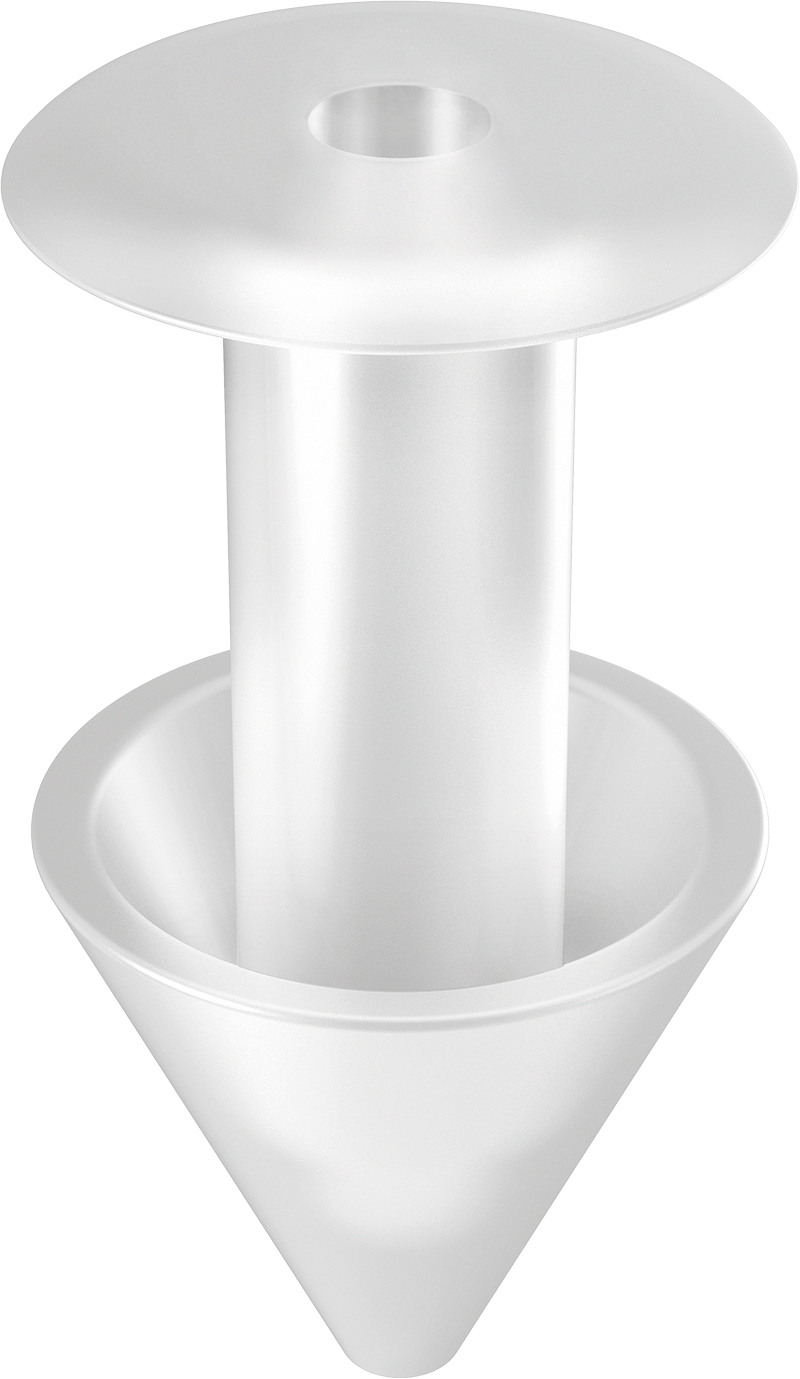
Punctal plugs are small devices inserted into the punctum to occlude the lacrimal drainage pathway, increasing both tear volume and tear residence time on the ocular surface. The mechanism is straightforward: by impeding outflow through the canaliculus, plugs allow the patient’s own natural tears—and any topical medications—to remain in contact with the ocular surface longer.
Research confirms that this simple intervention improves functional visual acuity, Schirmer scores, tear break-up time, and goblet cell density, while reducing vital dye staining and alleviating DED symptoms. (Source: Dr. Alan Kabat, OD, FAAO)
Who Are Punctal Plugs For?
Punctal plugs are appropriate for a broader range of patients than many clinicians realize. Primary candidates include:
Aqueous-deficient dry eye patients
Anyone presenting with reduced tear volume, rapid tear break-up time, or a symptom profile consistent with DED—including those with underlying systemic conditions such as Sjögren syndrome or rheumatoid arthritis—should be considered for punctal occlusion.
Contact lens wearers
Dry eye is among the most common drivers of contact lens dropout. When a lens dehydrates, it pulls natural tears from the ocular surface—a cycle that damages goblet cells and corneal epithelium over time. Punctal occlusion increases tear volume at the source, helping contact lens patients achieve better comfort and longer wear time. (Source: Dr. Eric Brooker, OD)
Pre- and post-surgical patients
Undiagnosed or untreated DED is a leading cause of inaccurate keratometry readings before cataract surgery—and of patient dissatisfaction afterward. A 14-day treatment protocol combining preservative-free drops and punctal occlusion can stabilize the ocular surface before IOL measurements are taken, improving accuracy and reducing the enhancement rate. (Source: Dr. Craig McCabe, MD, PhD, FACS)
Patients with seasonal allergic triggers
Seasonal allergic conjunctivitis can disrupt the tear film and temporarily worsen dry eye symptoms. A mid-term temporary plug allows you to increase tear volume during high-allergy periods without committing to a permanent solution.
Patients on preserved OTC drops
Long-term use of drops containing benzalkonium chloride can itself damage the ocular surface. Punctal occlusion increases natural tear volume, reducing a patient’s dependence on preserved artificial tears.
Referrals from rheumatology
Rheumatologists frequently send patients who’ve tried multiple drops without adequate relief. Punctal occlusion often succeeds where drops have not—and successful outcomes generate continued referrals.
Where Punctal Plugs Fit in the Treatment Algorithm
Punctal plugs were a first-line DED therapy for decades before a shift toward anti-inflammatory pharmacotherapy in the mid-2000s temporarily displaced them. That has changed. The TFOS DEWS II Report (2017)—the most comprehensive consensus document on DED management—repositions punctal plugs earlier in the treatment sequence: after non-preserved ocular lubricants, but before prescription anti-inflammatories such as cyclosporine or lifitegrast.
This is clinically significant. Unlike topical pharmaceuticals, punctal occlusion is directly reimbursable by most third-party insurers under CPT 68761—a billable procedure that generates up to approximately $255 for four-puncta occlusion, compared to roughly $70 for a general eye exam. Plugs expand your therapeutic reach and your practice’s financial health simultaneously. (Source: Dr. Brooker; Dr. Kabat)
For complete billing guidance, including CPT 68761 modifiers, ICD-10 codes, and multi-puncta reimbursement rules, see Lacrivera’s Billing Guide for Punctal Occlusion.
The Procedure
Punctal plug insertion is a quick, in-office procedure—non-invasive, non-surgical, and well-tolerated by most patients. It requires no anesthesia and is typically completed in minutes. The procedure is covered by Medicare and most third-party insurance plans.
Standard practice is to start with lower lid occlusion and assess for tolerance before proceeding to the upper lids if additional occlusion is warranted.
Types of Punctal Plugs
Punctal plugs fall into three broad categories based on duration and material. Choosing the right plug depends on the clinical situation, the patient’s history, and your intended outcome.
Short-Term Temporary (7–10 Days): Collagen Diagnostic
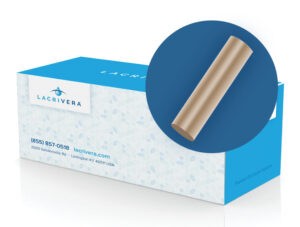
VeraC7™ Collagen Inserts
Collagen plugs provide highly effective occlusion in the first two to three days post-insertion and absorb completely within 7 to 10 days. They’re the appropriate starting point for any patient who has not previously had punctal occlusion: a low-commitment, low-risk way to confirm that the patient will benefit and tolerate the procedure before moving to a longer-duration option.
Mid-Term Temporary (60–180 Days): Synthetic Extended
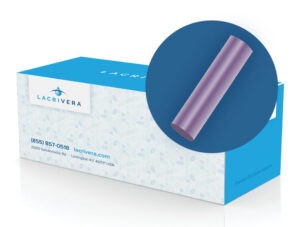
Vera90™ Synthetic Extended Inserts
Made of ε-caprolactone/L-lactide copolymer (PCL), Vera90 inserts absorb in 60 to 180 days and reside entirely within the canaliculus—making them a well-tolerated option for patients with mild nasal chemosis, where an exposed silicone cap might cause irritation. The intracanalicular design also suits seasonal allergy patients, where temporary relief during peak-symptom periods is the goal.
Long-Term Temporary (~6 Months): Synthetic Absorbable
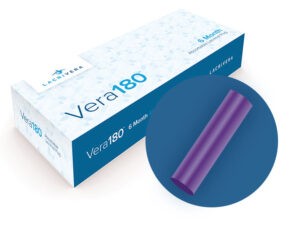
Vera180™ Synthetic Absorbable Lacrimal Plugs
Vera180 provides extended temporary occlusion lasting approximately 180 days. Made of poly-p-dioxanone (PDO), it’s an excellent option for post-surgical patients (post-LASIK, post-cataract), or for any patient who would benefit from sustained occlusion without committing to a permanent device. Dr. McCabe specifically recommends the Vera180 for preclinical to mild DED patients in his pre-cataract surgery protocol.
Permanent — Standard Occlusion: Silicone
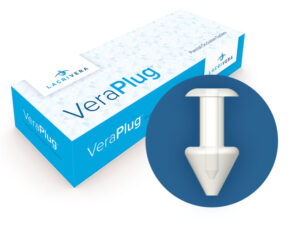
VeraPlug™ Punctal Occlusion System
The VeraPlug is a silicone punctal plug designed for simple, effective treatment of chronic dry eye. Its proprietary shaft design provides excellent retention and proper anatomic fit; the low-profile dome minimizes patient awareness. Available in four sizes (Small through X-Large, 0.4–1.0 mm punctal openings) in both sterile preloaded and nonsterile bulk configurations.
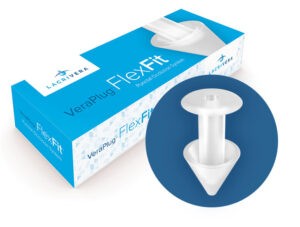
FlexFit™ Punctal Occlusion System
The FlexFit is Lacrivera’s premium silicone plug, engineered with a unique collapsible nose design for easy insertion and excellent retention. Two sizes fit most patients, with four sizes total to accommodate punctal openings from 0.2 to 1.0 mm. Available in sterile preloaded and nonsterile bulk configurations. Backed by Lacrivera’s 30-Day Retention Pledge: if a plug is lost within 30 days of insertion, we’ll replace it free of charge.
Permanent — Partial Occlusion
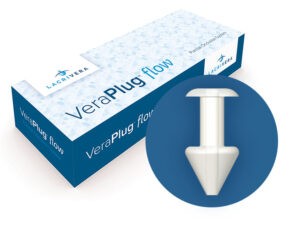
VeraPlug™ Flow Punctal Occlusion System
For patients who benefit from punctal occlusion but experience epiphora with full occlusion, the VeraPlug Flow offers a clinically useful middle ground. Its perforated inner channel reduces—but does not eliminate—tear drainage, providing partial occlusion with the same anatomic fit and retention characteristics as the standard VeraPlug. Dr. McCabe recommends the VeraPlug Flow for moderate DED patients in his pre-cataract surgery protocol.
Frequently Asked Questions
Are punctal plugs permanent?
Silicone punctal plugs are considered permanent but are easily removed during a routine office visit. Temporary options (collagen and synthetic) dissolve on their own without removal.
Do patients feel the plug?
Most patients have little to no awareness once a properly sized plug is inserted. The VeraPlug and FlexFit both feature low-profile domes to minimize any sensation at the lid margin. Intracanalicular options (Vera90, Vera180) are not externally visible at all.
Can punctal plugs be used alongside eye drops?
Yes—and they often should be. Punctal occlusion and topical therapy are complementary; studies show that combining plugs with anti-inflammatory drops can produce greater improvement than either treatment alone. Plugs also reduce the frequency with which patients need to instill drops.
Who should not receive punctal plugs?
Patients with active ocular infection, significant conjunctival inflammation localized near the punctum, or known hypersensitivity to silicone are generally not candidates. Patients with epiphora from causes other than DED should also be evaluated carefully before proceeding.
What size plug does my patient need?
Accurate sizing is critical for retention and comfort. Use a punctal gauge to measure the punctal opening before selecting a plug. Each Lacrivera product comes with a size chart. If in doubt, the FlexFit’s collapsible nose design provides additional flexibility for borderline sizing cases.
Shop Lacrivera Punctal Plugs
Lacrivera offers the complete punctal occlusion workflow—from diagnostic temporary to permanent silicone—built for the specialty dry eye practice.